
Luxembourg has completed a series of four professional learning workshops introducing primary teachers to data literacy and core concepts of data science and AI.
Following a small-scale experimentation phase in autumn 2024 with six teachers including a pilot project on tree identification and climate data, the large-scale rollout ran from October 2025 to May 2026. Training was offered in three formats: two series of four three-hour sessions at IFEN, Luxembourg’s national teacher training institute (one with additional online reflection meetings for four teachers, one for 15 media-education “multiplier” teachers), and a third, school-embedded format delivered directly in schools by the multiplier teachers.
Participation remained remarkably stable across the four workshops, with 26 to 28 teachers attending each session:
- Workshop 1 – Data, Telling a Story: Teachers explored where data appears in the curriculum and tried out hands-on activities such as Lego sorting, the Nim game and Teachable Machine, illustrating different types of machine learning.
- Workshop 2 – Classification, Decision Trees & Prediction: Starting from the question of whether folklore versus statistical forecasting, teachers worked through the popular “What are the Gnomes doing?” task and the playful Good-Monkey-Bad-Monkey game before building decision trees by hand using food-nutrition cards.
- Workshop 3 – Recommender Systems & Big Data: A Netflix-style recommendation scenario and hand-drawn sociograms, later visualised in Orange, opened discussions on how big data is collected and used — and its ethical implications.
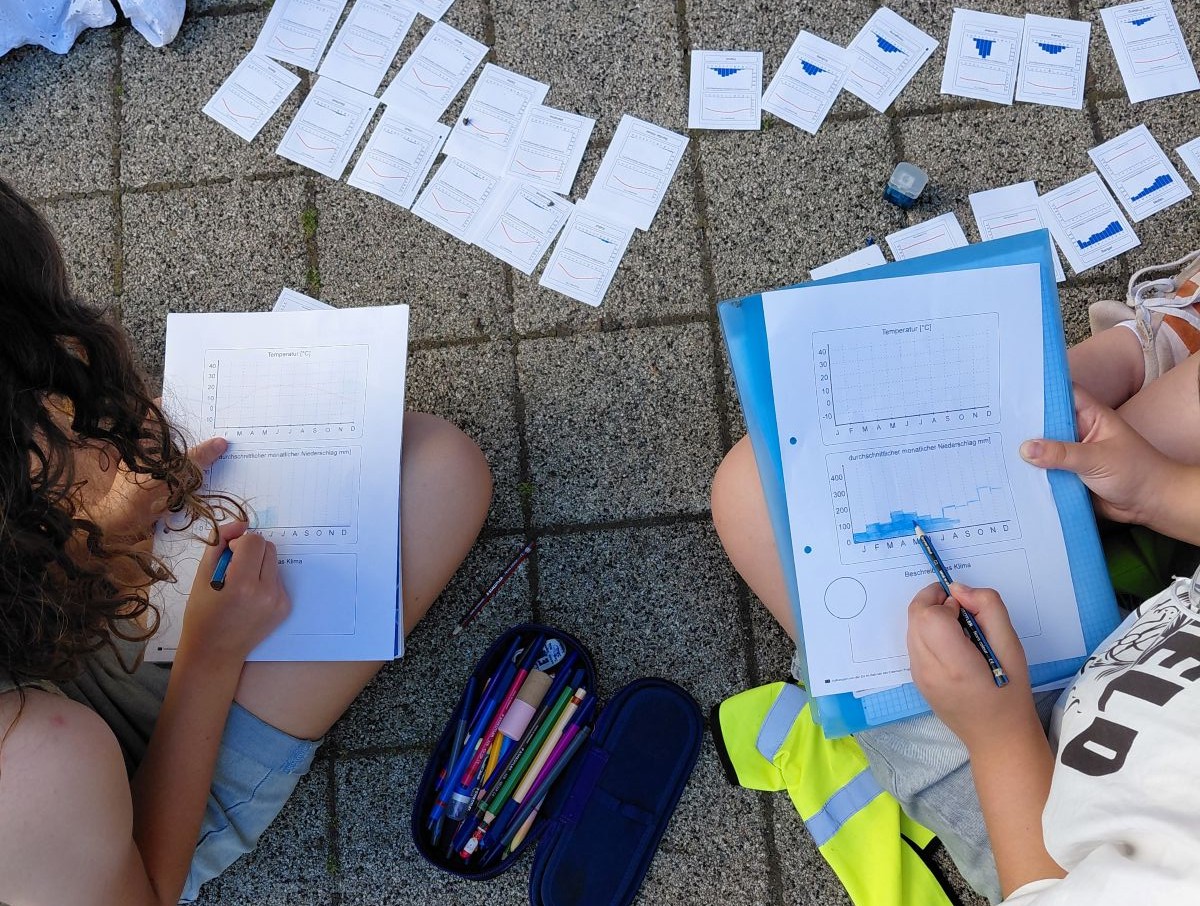
- Workshop 4 – Clustering: Teachers grouped climate diagrams of Asian cities by hand, then tested whether Orange Data Mining could replicate their clustering across hundreds of cities, complemented by an unplugged k-means clustering activity.
Feedback from participating teachers was strongly positive throughout, with core concepts consistently rated as clear and relevant by well over 85% of respondents. Across all four sessions, the unplugged, hands-on activities stood out as the element teachers valued most.
